

|
||
|
Dream Machine: M400 Skycar A car that makes highways obsolete may be more than pie-in-the-sky. The promise — after many false starts — of the Skycar. Partially
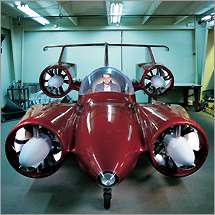
assembled, the M400 prototype shows the ducted fans that each
house two rotary engines to provide thrust for vertical takeoff
and forward flight |
||
|
When the bubble canopy is lowered, enveloping you in the M400 Skycar's cockpit, you become lost in its possibilities. The single stick that controls pitch, yaw, and direction falls to hand. Eight ignition switches and starter buttons are at the ready. The hood slopes away, braced by two rounded ducts housing four of the eight rotary engines that lift you with 720 horsepower, then launch you into the sky at more than a mile a minute. The M400 is a flying car that promises to let you take off from your backyard — assuming you have a pretty big backyard — and fly to your destination at 350 mph, ignoring, if not gazing condescendingly upon, land-bound commuters stuck in traffic below. The brainchild of 63-year-old Paul Moller, the M400 lifts off on the thrust of four sets of shrouded, ducted fans — quieter and less dangerous to your neighbor than a helicopter. In forward flight, the low drag of its lifting surfaces promises twice the speed of a rotary wing. Its control system should make it as easy to fly as driving a car — unlike a helicopter, which requires a highly skilled pilot. But for now, the M400 sits in a Davis, California, shop, where its promise has both tantalized and frustrated supporters and lent ammunition to detractors for nearly a decade. To get to this point,
Moller has spent a personal fortune and millions of dollars in
investors' money tackling problems that have daunted aircraft
designers for half a century. Vertical takeoff is a relatively
minor hurdle: Developing a lightweight, low-cost, reliable powerplant;
computer controls; and a way around the peril of turning an average
driver loose in such a craft are more challenging.
Moller himself is an articulate, successful inventor-entrepreneur and former college professor with a Ph.D. in aeronautics. And he not only believes in flying saucers, he owns one. The M200X, a predecessor to the M400, was developed to test the ducted fan-controls and prove the engines could provide thrust capable of liftoff. It has been flown some 150 times, both unmanned and with Moller himself nervously at the controls. ("Most vertical takeoff and landing [VTOL] test programs have killed test pilots," he says, not joking.) The M200X has flown to altitudes of 50 feet, well out of ground effect — whereby the fans compress air under the craft, raising it a few feet. The circular shape
of the M200X was dictated by the need to arrange the lifting
fans symmetrically. So it resembles a relic from the Jetsons;
saucers flitting in the air around the back of Moller International
Corp. have long been part of company lore. The notion prompted him to build a helicopter when he was 14, in rural Canada, and would turn into an obsession. Moller barely graduated from high school, spending most of his time building a car from stray parts. A professor at McGill University got him enrolled there despite the academic shortcomings; Moller rewarded that faith with a career that led to a Ph.D. and a professorship at the University of California at Davis in 1963. His stint in academia paralleled a hands-on approach to engineering and a short career in motorcycle racing that led to the development of Supertrapp, a sound-deadening muffler system that became a multimillion-dollar business.
But the urge to build a free-flying aircraft unrestrained by the need for conventional airports remained. At Davis, he embarked on the construction of the first of a series of saucer-shaped craft that promised to lift vertically and go anywhere. Early efforts were thwarted by the lack of a low-cost engine with sufficient power, but Moller saw the future in the then-radical Wankel engine. Under development by several auto companies, the Wankel replaced conventional pistons, cylinders, and connecting rods with a triangular rotor housed in a trochoidal-shaped chamber — an oval that creates compression and expansion as the rotor turns around. The Wankel has three combustion chambers around a central crankshaft, and a rotary motion that makes the motor easy to balance. Embraced, then rejected, by GM, Wankels powered several European cars. Today, Mazda is the only major automaker with a rotary engine in volume production. The high power-to-weight ratio, its short, stiff crankshaft capable of handling propeller torque loads, and the compact shape seemed ideal for a small aircraft engine — and in fact, Curtiss Wright and John Deere pursued this theme. But not as persistently as Moller, who saw an alternative to gas turbines, and the key to low-cost vertical flight. The two-engine XM-2, in '65, lifted only high enough to show air under its tires. In ground effect, the plane was too unstable to fly safely any higher. The underpowered XM-3, in '68, was a single giant turbine blade, with the pilot in the hub. The multiple fans of the XM-4, in '74, proved only marginally better for thrust, despite using the first Wankels. Control proved the most critical problem. Thrust-lifted aircraft have no inherent stability — the direction of thrust controls the balance, while a failed engine can flip one over instantaneously. Moller proceeded cautiously until he developed analog controls and a fly-by-wire system that controlled and balanced the engine thrust via computers. He demonstrated free flight in the M200X in 1989, more than two decades after the XM-2 first lifted off. He began working on the prototype for a multipassenger, high-performance flying car in '90, adding forward flight to the requirements, and the result was a design that had horizontal ducted fans with venetian-blind-like deflectors to provide downward thrust for vertical takeoff. The M400 Skycar was first put on display in '91. Its rakish
stance caught the imagination, as did the too-optimistic promise
it would be flying in a year or so. Today, Moller admits he underestimated
problems, from cash flow to air flow to development time. Most of the development during the '90s involved the engine. Redesigning the rotor, sealing system, and cooling boosted the output some 50 percent; the single-rotor design evolved into modules that could be stacked to make multiple-rotor engines. Controls were digitized. A rear wing provides 25 percent of the lift at 150 mph, the speed at which it has transitioned into conventional flight; the nacelles act like cylindrical airfoils. There are no controllable airfoils, other than deflector vanes in the ducts. Attitude is controlled by the variable thrust of the fans. Two rotary engines in each nacelle drive separate fans, for safety.
The fixed horizontal ducts provoke criticism from some engineers, mainly because of the loss of thrust when the airflow is redirected downward for lift-off. An alternative, fans that rotate from vertical to horizontal to achieve forward flight, was rejected because of the potential for stalling. A push became earnest in late '98. Delays with the electronic controls and fan aerodynamics marked '99 until a first test flight was promised this past February. "We misjudged the complexity of some problems," Moller says, such as vibration induced by airflow between the fans in the nacelles. The engines mounted in December were single-rotor, 70-horsepower powerplants, rather than the two-rotor, 120-horsepower engines still under development. The larger engines are necessary to produce the predicted performance, but the lower power would effectively demonstrate VTOL capability. Control systems were still being installed, and full-power nacelle tests had just been completed. The first demonstration of the M400 itself is intended to show the vertical takeoff and maneuverability. More difficult full forward flight will be part of a future test program. The first demonstration should defray some of the skepticism of engineers who feel the problems of VTOL aircraft remain. Greatest of these is the need for large amounts of power and minimum weight to achieve thrust-lifted takeoff. The extra power becomes overkill in level flight, hurting fuel economy and range. VTOL capability also limits payload, compared with helicopters or conventional aircraft. Here the rotary engines, low-cost and capable of providing short bursts of power and then throttling back in level flight, are key. The ultimate success of the Skycar depends on volume production of the engine and airframe to keep costs low. But that can happen only by eliminating the need for a skilled pilot. Yet what seemed farfetched two decades ago now is within theoretical reach. GPS, Moller anticipates, could form the basis for a central "highway-in-the-sky" — elements of which are now under control for conventional aircraft — that governs individual aircraft, keeping them in safe corridors. Moller — and some experts from NASA itself — sees such corridors as having the potential to safely carry highway-style traffic. This, of course, would require an airspace revolution. "Flying limousines" from airports, or flying jeeps for the military, are more reachable. But Moller remains optimistic. Solutions, for him, are just around the corner. |

|


